

Change begins with awareness.
This week marks the start of our latest Positive Academia campaign—focusing on identifying the habits and patterns that quietly shape our everyday academic interactions.
In meetings, whose voice is the loudest?
Not just in volume—but in frequency, influence, and interruption.
- Who speaks first… and most often?
- Who gets listened to… and who gets overlooked?
- Whose ideas are amplified… and whose are unintentionally sidelined?
These patterns are rarely intentional. They are built through routines, hierarchies, confidence, norms, and time pressures. But left unexamined, they shape whose knowledge counts—and whose does not.
This week’s micro-action: Observe without judgment.
In your next meeting:
- Notice who speaks, how often, and for how long
- Pay attention to interruptions, acknowledgements, and silences
- Reflect on your own participation—are you taking space, holding back, or creating space for others?
This is not about blame. It is about awareness.
Because before we can change academia, we must first see the patterns we are part of.
Reflection questions:
- When I speak in meetings, how much space do I take—and why?
- Whose contributions might I be unintentionally overlooking?
Let’s begin here. Quietly. Thoughtfully. Together.
Remember the Lion’s Roar!
“In the academic zoo, the lion’s roar served as the law. Each morning, his booming voice echoed through the habitats. The peacocks’ ideas, though dazzling, were dismissed as trivial. The diligent ants, who worked tirelessly, were completely overlooked.
One day, the nightingale attempted to sing during the lion’s speech. Her melody was soft yet profound. The lion silenced her. “Roaring is what matter here,” he declared. However, the animals began to recognize the imbalance in their voices. Gradually, they tuned out the lion and gathered to actively listen to the nightingale’s songs, the ants’ whispers, and even the owls’ hoots at midnight.”
Moral – in academia, we must value diverse voices, not just the loudest ones.
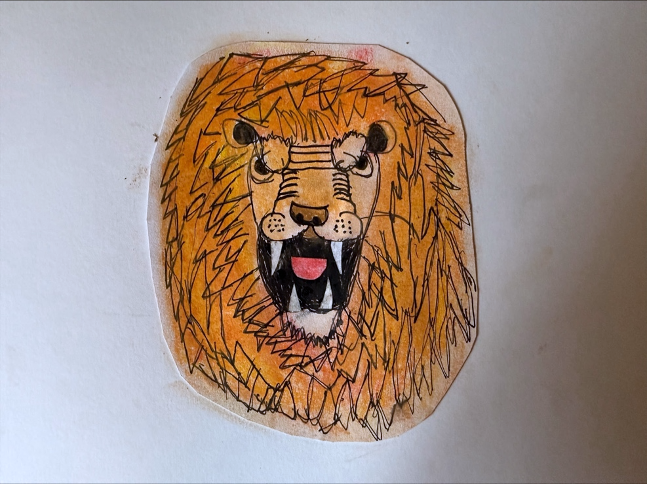
Ilustrated by Nila Sathish