

Last week, we started by noticing whose voices are heard in our meetings.
This week, we focus on something equally powerful—whose scholarly work gets recognized.
What do we praise in academia?
- Which papers are described as “top”, “rigorous”, or “important”?
- Which journals, methods, or topics are celebrated—and which are quietly dismissed?
- Whose work do we cite, recommend, or elevate in conversations?
Praise is never neutral. It signals value. It shapes careers. It defines what “counts.”
And often, without realizing it, we reproduce the same patterns:
- Prioritizing certain journals over meaningful contributions
- Valuing methodologies while overlooking others
- Celebrating familiar names while missing emerging or marginalized voices
This week’s micro-action: Notice patterns of praise.
In your daily academic interactions:
- Pay attention to how colleagues talk about research
- Notice what gets validated, and what gets questioned or ignored
- Reflect on your own language—what do you instinctively praise?
Again, this is not about blame. It is about awareness.
Because what we praise shapes the future of knowledge.
Reflection questions:
- What assumptions guide what I consider “good” or “valuable” research?
- Whose work might I be overlooking because it does not fit dominant norms?
Small awareness leads to meaningful change.
🐜🐜🐜Remember the Fire Ants’ Colony! 🐜🐜🐜
In a quiet corner of the Academic Zoo, a colony of fire ants worked tirelessly. Their contributions were immense: tunnels that aerated the soil, structures that supported the ecosystem, and a network of labour that connected every corner of the zoo.
But their efforts were rarely acknowledged. “They are too small to matter”, said the lions, who basked in the shade of the trees nourished by the ants’ work. One day, the ants’ queen called for a rest. “We’ve done enough unseen labor”, she said. “Let’s show the zoo what happens without us.”
As the ants stopped their activity, the soil hardened, plants began to wilt, and the once-thriving habitats started to decline. The zookeepers panicked, and the larger animals demanded answers. “It was the fire ants all along”, whispered the sparrows.
When the ants resumed their work, they did so under new conditions: recognition, fair treatment, and a voice in the decisions that shaped the zoo.
Moral – Academia often relies on invisible labor. Recognizing and valuing this work is essential for its sustainability
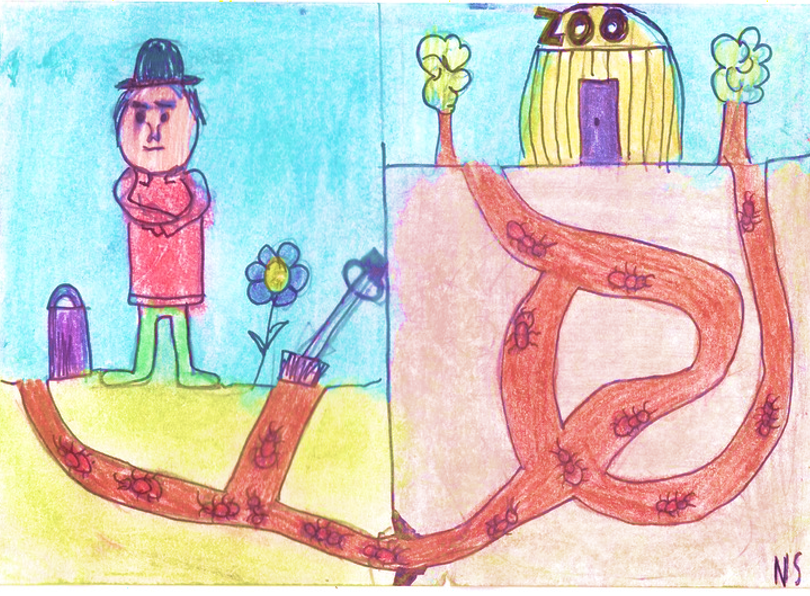
Illustrated by Nila Sathish